
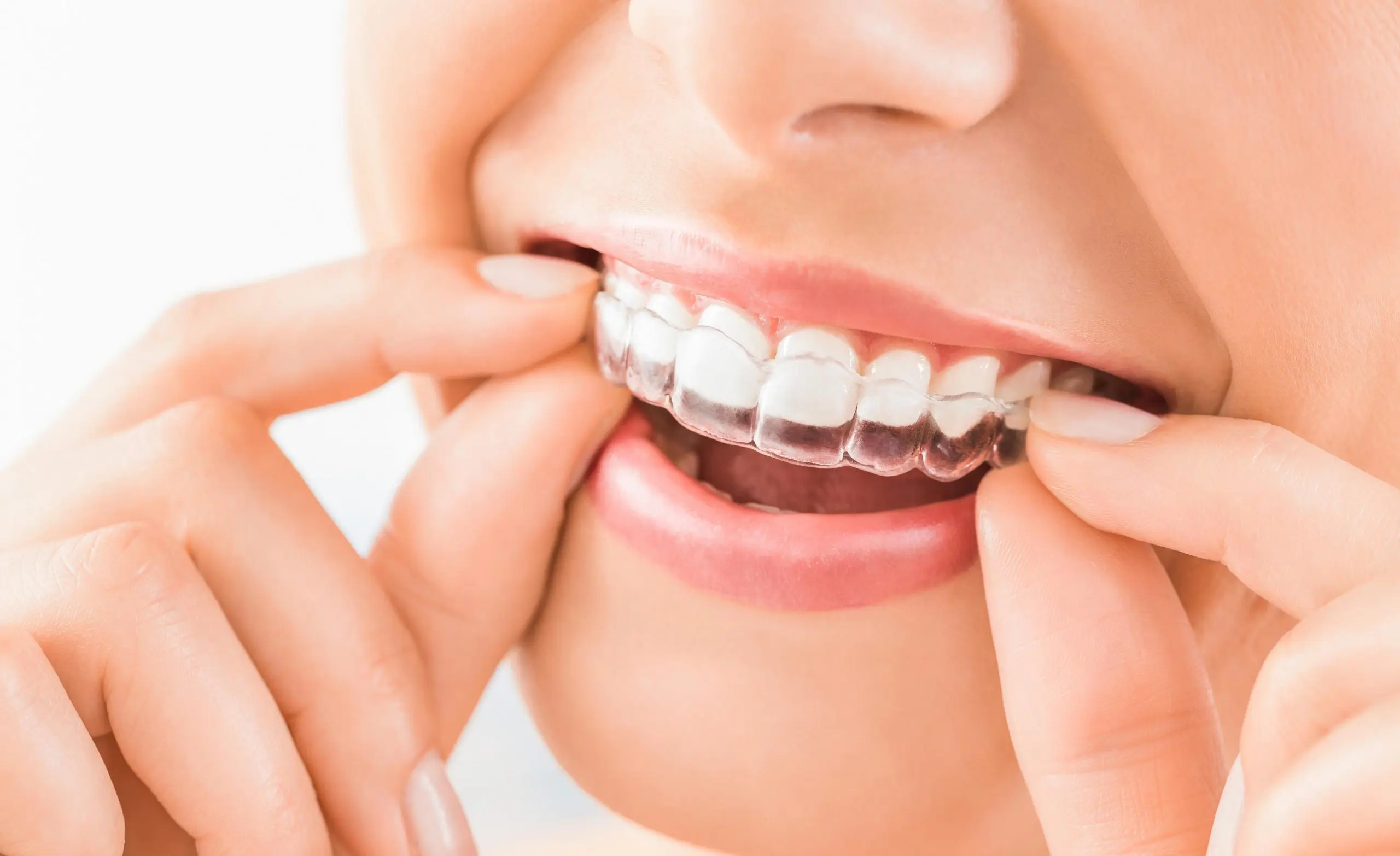
Types of malocclusions fixed by Invisalign
There are quite a few misconceptions around today about Invisalign and clear aligners. A common stipulation is that clear aligners are only effective for small, minor bite problems. But this is not true.
As experienced orthodontists and cosmetic dentists, we have seen just how successful Invisalign can be in treating the following:
- Crooked and overcrowded teeth
- Overbites, underbites, and crossbites
- Gaps up to 6mm wide
Experiencing any of the above? Book your Invisalign consultation today.
Home | Braces | Invisalign | Treatable cases

how are they treated?
Invisalign has been a game-changer at advancing traditional orthodontics.
The strong and invisible plastic aligner system has helped millions of people and orthodontic patients across the globe, providing better aesthetics and effective repositioning.
Overbites/overjet
- Occurs when the upper teeth bite over the bottom teeth – the cause of this can be genetics, poor oral habits or an overdeveloped bone structure.
If you have an overbite, it’s likely important to have this problem fixed to avoid future oral health and hygiene issues that can encourage the formation of infections like gum disease.
Overbites with Invisalign can take anywhere from 9-12 months, depending on the severity of the overlap.
Underbites
- This happens when the lower front teeth protrude over the upper teeth, often occurring when the upper jaw is underdeveloped, or the bottom jaw is overdeveloped (sometimes a combination of the two).
An underbite can make chewing difficult as the front teeth and molars are prevented from functioning normally.
The negative oral health consequences of ignoring an underbite can lead to teeth deterioration, making them worn and causing jaw joint issues.
Other Problems
Crossbite
- Crossbites often mean a patient’s jaw is crooked, which means teeth can line up very strangely (where one or more of the upper teeth come into contact with the inside of the lower teeth).
Like other alignment problems, crossbites can cause many oral health issues like gum disease, bone loss (eventually tooth loss) and worn teeth.
Plus, due to the strange alignment, teeth can look unsightly and make patients self-conscious about their smiles.
Gapped teeth
- Gaps might appear in just one area of your smile or can be present throughout the mouth. The cause of gaps can be several reasons; however, the leading causes can be abnormal jawbone growth or tooth loss, which leads to other teeth trying to fill the space.
Gaps in the mouth often lead to gum disease, which can become a more serious periodontal disease as dark pockets form.
It’s essential to fix gaps in the mouth because gums rely on the protection of teeth, without this protection gums are more susceptible to problems.
Open bite
- This malocclusion occurs when teeth do not sit together and the jaw is completely closed. In other cases, front teeth do not make contact in an open bite; this is caused by genetics or an abnormal jaw structure. It’s also caused by habits such as thumb-sucking.
Chewing in these instances can be difficult and even painful, in life, it can cause speech impairments and increases the patient’s chance of contracting thermo-mandibular joint disorder (TMJ).
Overcrowded & crooked teeth
- People with small jawbones often experience overcrowding because there is not enough room in their mouth for all their teeth. This leads teeth to become pushed together, and this force will continue to make them in a crooked position.
Crooked teeth develop gum disease much more easily, this is because when the teeth push together and overcrowding occurs food is easily more stuck between teeth. And as overcrowding makes flossing more difficult, keeping the gums clean and healthy can become a problem.
Once plaque and tartar are allowed to accumulate, gingivitis will form, leading to more serious forms of gum disease. Periodontal disease cannot be reversed.
Pay For Invisalign Monthly With 0% Finance
Pay monthly with 0% interest for amazing, discreet dental solutions that realign your smile. Our recommended cosmetic treatments have left thousands of patients feeling better and more confident about their appearance and how their smile functions.
We’ve seen above that Invisalign can correct many alignment issues.
However, like any dental treatment, Invisalign has its limitations.
Invisalign tends to work the same as conventional braces, just without the brackets and wires – so situations where it cannot help, and conditions it cannot treat tend to include severe bite problems that might need jaw surgery to correct.
Examples of where Invisalign cannot help include situations where gaps in the mouth are too large and when a crooked tooth needs to be rotated to be straightened.
In certain situations, Invisalign may not be capable of doing this.
Invisalign also cannot raise or lower the position of your teeth or correct midline discrepancies bigger than 2mm.
Unsure about the above? See if you qualify for Invisalign – speak to a dentist: 01992 552115.
invisalign reviews: what our patients say
“I cannot thank Dr Doshi and all his amazing staff enough for making me feel so comfortable and at ease. They have given me something that I have always missed, the confidence to smile, I wish I had taken the step to enhance my life earlier. The Perfect Smile is unlike any other dentist that I have attended. The friendly atmosphere and facilities are second to none. Not once was I put under any pressure to go ahead with my treatment, but I’m glad I did. Worth every penny. Look out for anyone who’s holding a camera”. – Janet S.
“Fantastic service, very professional and friendly. Everyone made me feel very welcome every time I visited. I am thrilled with my new smile, they have done an amazing job. I no longer have to worry when I smile, it’s such a relief. Highly recommended and worth the time and effort to endure a brace. It is so worth it in the end – I love my new smile! 🙂 “– Tamsin X.
invisalign before and after images
Start your journey, book a consultation today! call 01992 552115.
Free Consulations
Major UK Credentials